Designing a slower exit for technical textiles.
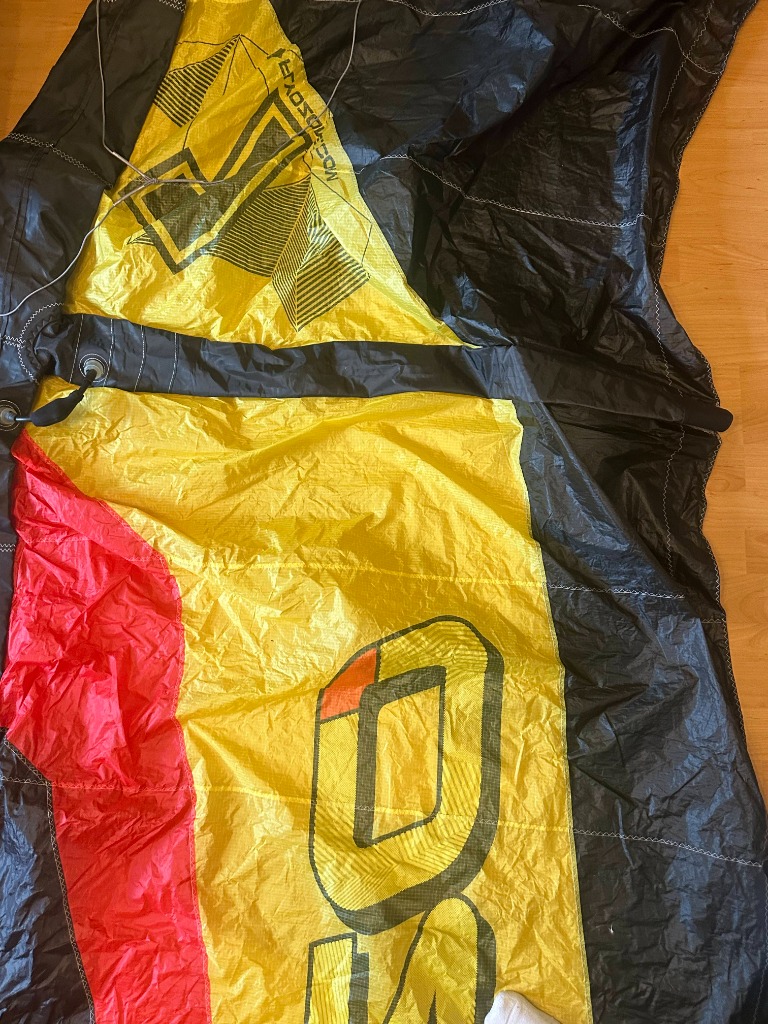
Every year, up to 250,000 kiteboarding canopies are discarded. This project intercepts a single canopy and cascades it into four nested products, using successive offcuts to keep the material in use for a decade longer. An honest exploration of circular textile design.
Is a longer material life genuinely wiser, or just a slower road to the same landfill?
Drag the slider to weigh ecological limits against commercial viability.
The Ecological Limits
-
Microfibre shedding doesn't stop. Keeping fabric in use delays landfill, but every product sheds microfibres while it's used. Longer life reduces the rate of new waste; it doesn't eliminate shedding. This is a mitigation, not a fix.
-
It still depends on new kites. A cascade like this only works as harm reduction, since it needs the industry to keep producing virgin canopies to feed it. It doesn't challenge that production; it cleans up after it.
-
The decade figure is a model, not a guarantee. The extra 10–15 years of service life is the designer's estimate based on how the products are used, not a tested, warrantied lifespan.
The Commercial Case
-
Resale models already work. Pioneering circular programs in apparel show that brand-run take-back can lower return friction and keep customers close. This applies that logic to gear nobody currently reclaims.
-
EU policy is closing in. Separate textile collection has been required since January 2025, and mandatory EPR schemes roll out across 2027–2028. A system like this turns a coming waste liability into a co-branding story.
-
The Baltic makes it buildable. Producing in Lithuania means short logistics loops, competitive labour, and EU-made provenance, close to the canopies' retirement, not an ocean away.
The Watersports Material Deficit
A fast-growing sport, no producer responsibility, and a material engineered to outlast everyone reading this.
Retirement Scale
Modelled against roughly 189,000 new kites produced in 2025 (designer's estimate), each with an active life of just 2–4 years. How this number was built →
Landfill Persistence
A canopy flies hard for 2–4 years. The high-strength ripstop polyester it's made of resists biological breakdown for centuries.
The Industry Gap
Major manufacturers run virtually no take-back programs. Collection and disposal fall to riders and local landfills.
The figures here (~189,000 kites, ~12 years, and the proposed carbon metrics) are my own models, built from public production estimates and material assumptions, not audited data. They're here to make the scale legible. Where a number carries weight in the argument, I show the assumption behind it.
The Nested Cutting Cascade
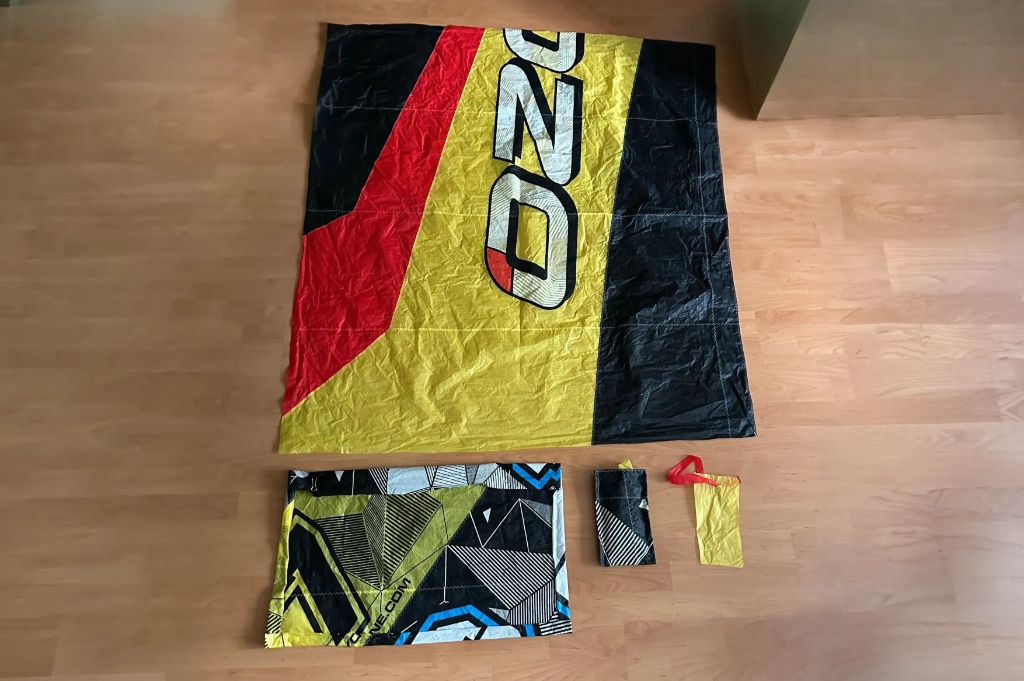
One canopy cut into four nested products, based on a real 7 m² technical canopy to show the actual cuts and scale of the system.
~12 Years combined
across 4 nested products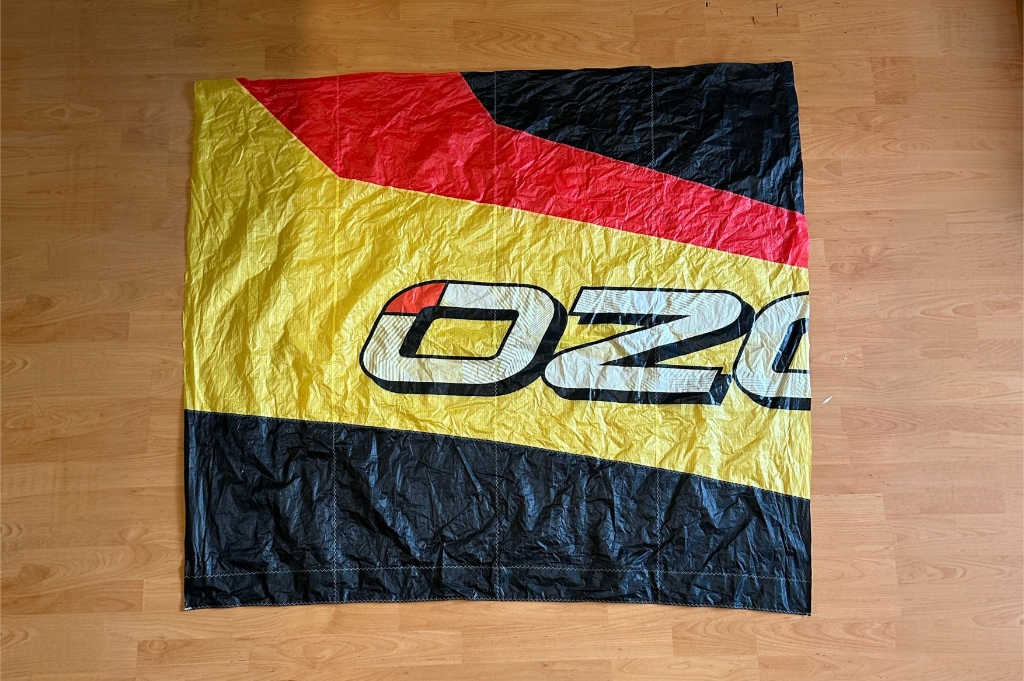
Edges are left as honest raw cuts and the corners reinforced by hand. No sewing, no heat, no glue.
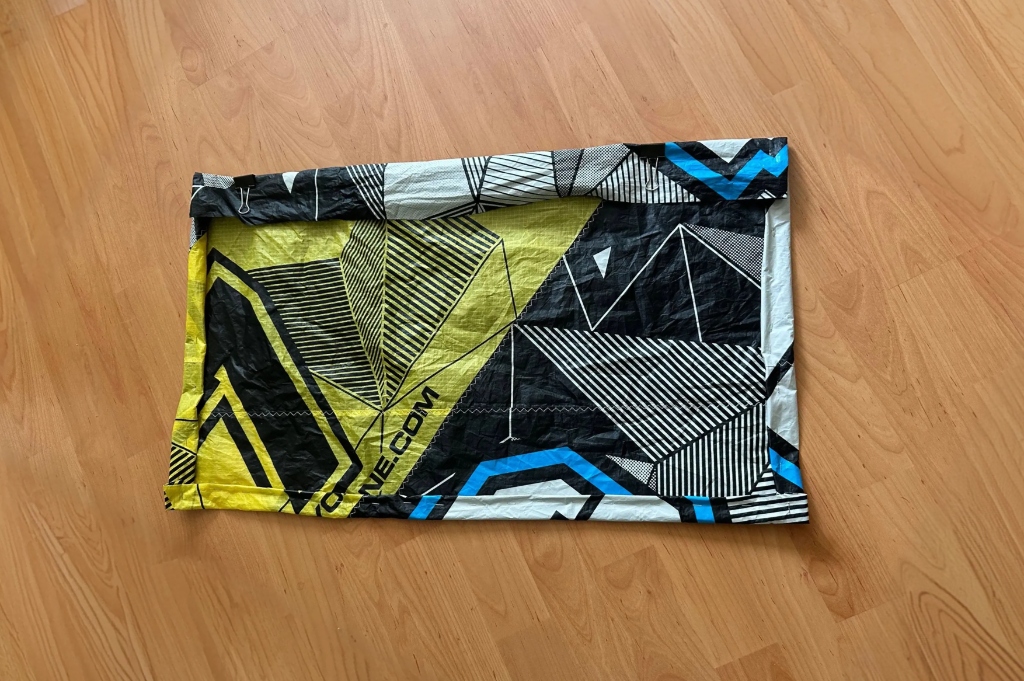
A wet-gear bag for kitesurfers, hand-cut and folded from mid-sized graphic panels. The sides and base are closed with rows of steel staples, leaving an open top. The construction is left visible, not hidden.
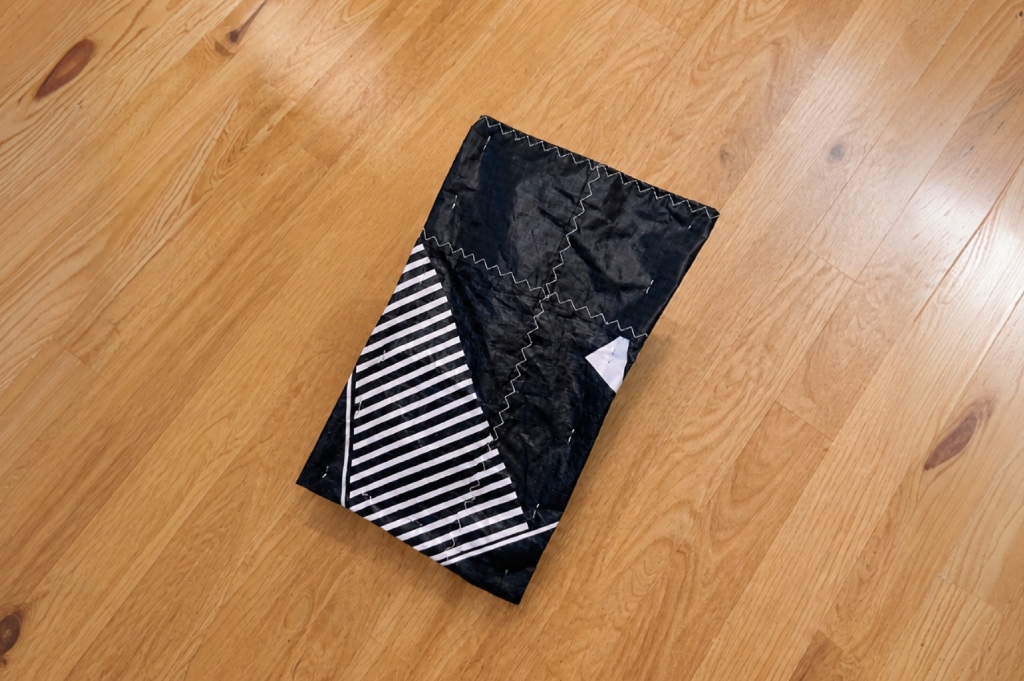
A small pouch for cards, keys, and loose items, folded flat from clean offcuts. One side uses the kite's original factory seam; the open side is closed with a row of staples. Raw-cut, functional, nothing added but the staples.
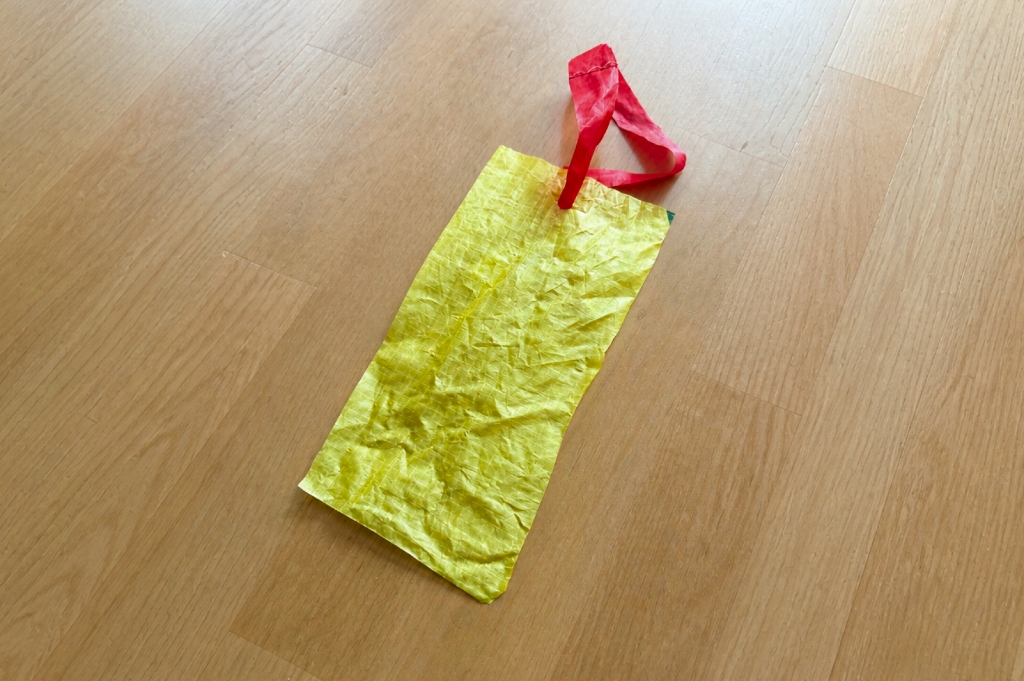
The smallest offcut, stapled into a luggage tag and hung on a loop cut from the canopy itself. The end of the cascade — the last scrap that still becomes something you'd keep. After this, the material's honest next step is recycling, not another product.
One technical canopy → four objects, largest to smallest. Cut, folded, and stapled — nothing added but staples.
Circular Strategy Map
Mapping the system across the three layers of circularity (Network, User, Operations) integrated with the interactive Rider's Journey.
Identifying Material Waste
Technical canopy polyester persists in landfills for 200+ years. Active flight life is only 2 to 4 years, yet the industry has zero Extended Producer Responsibility (EPR) or take-back loops.
No brand take-back systems exist from major commercial gear manufacturers. The industry has zero EPR participation, forcing sails into landfills.
Riders usually retire kites within 2 to 4 years. They hoard sails in garages or discard them directly into local municipal waste.
Mindaugas Navickas proposes a circular collection pipeline to recover retired sails, grading material integrity, sorting colors, and mapping clean ripstop panels.
The Lifecycle Journey of a Canopy
From high-flying watersports performance to localized circular products in Kaunas, Lithuania. Explore the stages a rider experiences.
The Canopy Trade-In
The trade-in. A rider requests a prepaid label from a co-branded portal, ships their retired kite, and gets a 20% circularity credit toward their next purchase.
Life 1: The Ground Sheet
Life 1: the ground sheet. Large sections are nested flat into a lightweight, water- and sand-resistant beach mat.
Life 2: The Stapled Tote
Life 2: the stapled tote. When the ground sheet wears, its offcuts become a threadless, open-top utility bag.
Life 3: The Stapled Pouch
Life 3: the stapled pouch. Tote scraps are folded and stapled into a pocket-sized sleeve for cards.
Loop: The Canopy-Strip Tag
Loop: the canopy-strip tag. The final narrow offcuts loop into a unique luggage tag. The intended end is chemical depolymerisation.
Canopy Trade-In & Carbon Passport
A mock-up of the brand infrastructure this would need: a circularity voucher and a logistics loop. The figures are illustrative models, shown to make the concept tangible.
~12 Years
Avoided Extraction
avoids virgin-polyester extraction for ~12 years.
4
Concept details: Models a 20% circularity credit on co-branded replacement gear. In the proposed system, a prepaid shipping label would be issued.
Locating Our Originality
Three projects got here first. Here's exactly where this one goes further.
KitePride // Tel Aviv
Upcycles donated kites into utility bags. Excellent collection proof, but restricted to a single extra life before ultimate landfill.
Freitag // Switzerland
The standard for heavy technical upcycling since 1993. They engineer one extra life; we cascade to four.
Ellen MacArthur // Global
Circular doctrine says keep materials at their highest utility. This nested system is a physical case study exploring that rule.
The Imminent Regulatory Horizon
EU textile policy is tightening on a clear timeline. A system like this gives a brand something ready to point at.
Separate Collection
All EU Member States must establish separate collection for textile waste.
Revised Framework
EU Waste Framework Directive (amending 2008/98/EC) adopts mandatory Extended Producer Responsibility (EPR) for textiles.
Transposition
Member states must transpose the directive into national law.
Mandatory EPR Live
Schemes must be operational. While technical watersports textiles sit outside current scopes, the compliance trajectory is clear.
The Sail Legacy Registry
Scan the QR tag on any piece at our table, or browse below to read each object's history.
The piece on display and the yield figures are both based on a real 7 m² technical canopy, showing the actual scale and cuts of the physical system.